
Targeted reduction of energy losses in magnetically coupled pumps
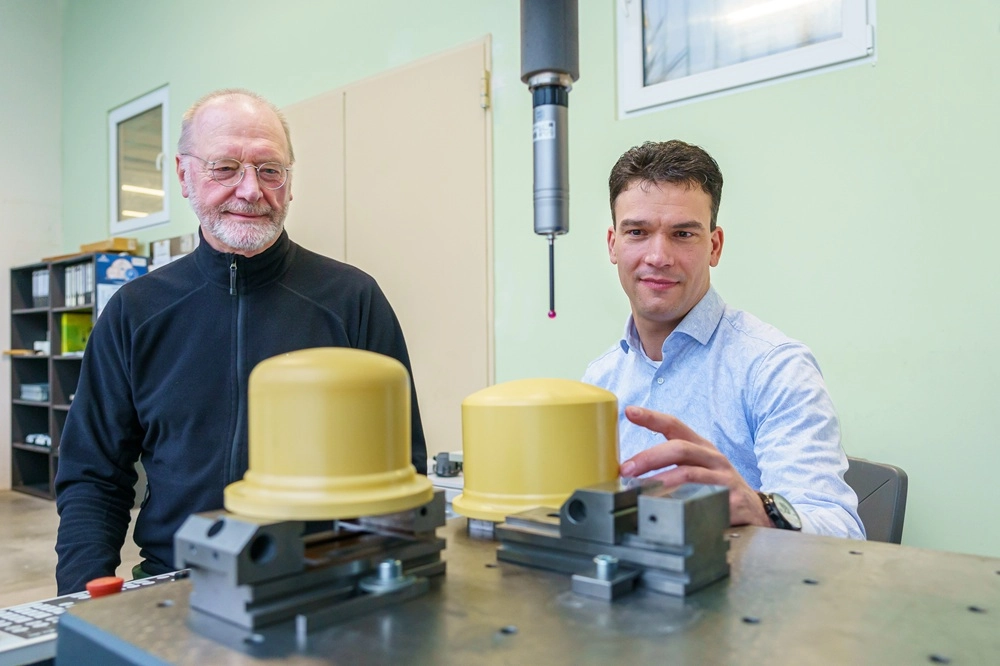
This article demonstrates how ceramic containment shells made from zirconia (Zirconia M) effectively eliminate these losses. We explain the underlying physical mechanisms and show why material selection is a decisive lever for improving energy efficiency, service life, and total cost of ownership (TCO).
Eddy Current Losses in the Containment Shell: Invisible Efficiency Losses
Metallic containment shells are electrically conductive. In magnetically coupled pumps, eddy currents are generated when the rotating magnetic field of the drive passes through the shell.
These eddy currents create an opposing magnetic field, which reduces the torque transfer between the inner and outer magnets. As a result, a portion of the electrical energy is not converted into pumping performance but is instead dissipated as heat directly within the containment shell.
Practical Impact
For a typical 50 kW pump operating continuously, this translates to:
- 15 % efficiency loss = 7.5 kW dissipated as heat
- Over 8,000 operating hours/year: ~60,000 kWh lost
- Additional consequences: increased cooling requirements and thermal stress on adjacent components
These losses are particularly significant in continuously operating applications, such as in the chemical industry or basic materials production, resulting in substantial energy costs.
Importantly, these losses are inherent to the system and can only be eliminated by selecting a non-conductive containment shell material.
Ceramic Containment Shells Made of Zirconia: No Eddy Currents, Maximum Energy Transfer
This is where the physical properties of high-performance ceramics come into play.
Zirconia M (zirconium oxide) is:
- Electrically non-conductive → no eddy currents
- Non-magnetizable → no magnetic damping
Unlike metallic containment shells, magnetic energy is transmitted from the drive to the pumped medium almost loss-free. Depending on pump type, power class, and operating profile, energy savings of up to15 % can be achieved.
Zirconia M is resistant to most aggressive chemicals - including acids, bases, and organic solvents - over a wide temperature range from -200 °C to +450 °C.
When Are Ceramic Containment Shells the Economically Superior Choice?
The use of ceramic containment shells is particularly advantageous in applications featuring:
- Continuous pump operation, where efficiency gains accumulate over time
- High operating temperatures (from approximately 300 °C)
- Aggressive or corrosive media
- Applications with stringent environmental and emission requirements
- Energy-intensive processes, where even small efficiency improvements are economically significant
In these scenarios, the energy savings and extended service life clearly outweigh the higher initial investment.
Technical details: Zirconia M as a material for ceramic containment shells
| Characteristic | Advantage |
|---|---|
| ⚡ Electrical conductivity | Non-conductive → no eddy currents |
| 🧲 Magnetic properties | Non-magnetisable |
| 🌡️ Temperature resistance | Dimensionally stable up to 450°C |
| 🔧 Pressure resistance | Test pressures up to 90 bar (depending on design) |
| 🧪 Chemical resistance | Resistant to aggressive media |
| ❄️ Thermal shock resistance | High |
| 📏 Thermal expansion | Similar to steel |
| 🌍 Environmental aspect | Leak-free coupling |
Detailed Material Information on Zirconia M
More than just a material - Rauschert’s engineering expertise
Rauschert develops ceramic containment shells not as standard components, but as application-specific solutions. Already during the design phase, Rauschert engineers support pump manufacturers and plant operators with material selection, geometry optimization, and consideration of thermal and mechanical boundary conditions.
The goal is to optimize energy efficiency, operational reliability, and service life holistically - rather than compromise with generic solutions.
Conclusion: Material Selection as a Strategic Lever for Efficiency
Ceramic containment shells made from Zirconia are far more than an alternative to metallic solutions. They eliminate eddy current losses, reduce the energy demand of magnetically coupled pumps, and increase operational safety, especially in energy-intensive industrial applications.
For those seeking to balance energy efficiency, plant availability, and low total lifecycle costs, material selection of the containment shell should be regarded as a strategic design parameter.
Talk to us about your application - our engineers will show you the energy efficiency potential in your pump.