Glass-ceramics in injection moulding: lessons learned from the project
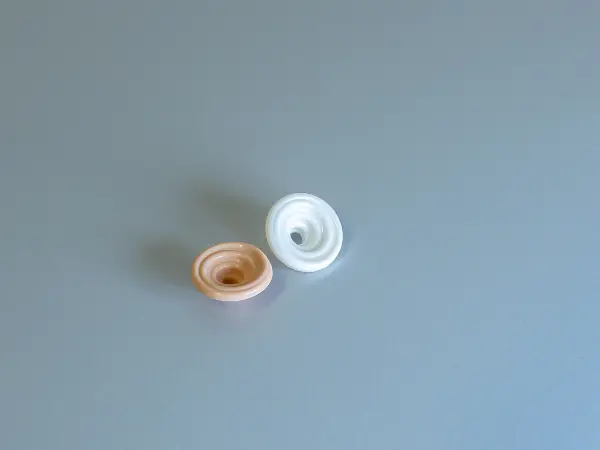
Demonstrator made of glass-ceramic (left) compared with an alumina take-off nozzle (right)
New insights into materials and processes
From January 2022 to September 2025, the near-net-shape production of glass-ceramic components was investigated as part of a funding initiative of the German Federal Ministry for Economic Affairs and Energy (BMWi) under the ‘Application-oriented non-nuclear R&D in the German Government’s 7th Energy Research Programme’. The Fraunhofer IKTS coordinated the collaborative project ‘EnerForminG: Reducing energy consumption and CO₂ emissions through near-net-shape manufacturing processes for glass-ceramics’. Other project partners included Alumina Systems GmbH, bifa Umweltinstitut GmbH and Dentsply Sirona / DeguDent GmbH. The composition of the consortium and the planning of the project’s scope were based on the entire value chain for the powder-based manufacture of glass-ceramic components. For Rauschert, the project offered the opportunity to supplement its existing expertise in the processing of technical ceramics with experience of a further material system.
A take-off nozzle for yarn guidance in textile technology was selected as a potentially suitable demonstrator for this material system. Such components are subjected to high wear loads during operation. The requirements regarding surface quality, geometry, and process stability are correspondingly high.
Our contribution: from feedstock to demonstrator
A key task for Rauschert was to develop extraction nozzles using powder injection moulding from an injection-mouldable feedstock based on lithium disilicate glass-ceramic.
This involved more than just the basic shaping process. The binder system and debinding process also had to be tailored to the properties of the initial glass powder on which the glass-ceramic is based. The subsequent sintering and crystallisation to form a glass-ceramic material were investigated in collaboration with the project partners under various industrial conditions.
The project resulted in high-quality demonstrator components with a homogeneous microstructure and only minimal residual porosity. Computed tomography scans revealed neither internal cracks nor trapped pores. A comparison with the original CAD design demonstrated that dimensional deviations were negligible, even in the case of complex internal geometries.
Understanding energy requirements along the process chain
Another key focus of our contribution was the energy analysis of the manufacturing process. To this end, production and energy data from the individual process steps were recorded at Rauschert and related to the demonstrator component.
This made it possible to identify where energy is required along the process chain and to assess how different manufacturing conditions affect the resulting CO₂ emissions. Of particular relevance was the lower firing temperature of the glass-ceramic material investigated compared with the reference component made from technical ceramics. The results provide important insights for a well-founded assessment of energy demand.
Successful collaboration between research and industry
The implementation of the entire process chain right through to the demonstrator was only possible thanks to the close collaboration between the participating research and industry partners. The different areas of expertise in materials development, feedstock production, sintering, characterisation and energy assessment complemented one another very well. In particular, the comparison of different industrial sintering conditions provided valuable insights for the entire project.
Valuable insights
The project has enabled Rauschert to process glass-ceramics in an industrial setting and to gain a better understanding of the technological and energy-related interrelationships. This experience helps us to assess future enquiries regarding such components on a more technically sound basis.
At the same time, the project has shown that processing glass-ceramics is a challenging task. The service life of glass-ceramic components also needs to be investigated and assessed in even greater detail for each specific application.
For Rauschert, the most important success of the project therefore lies in the understanding of the process that has been developed: we are now better able to assess the possibilities and limitations of the material and, where the requirements are suitable, consider it as a complementary option to technical ceramics.