
When can technical ceramics replace cemented carbide? 4 criteria for selecting the right material
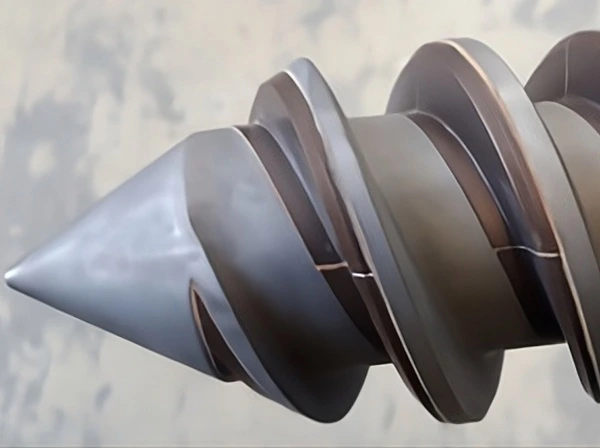
Extruder screw with wear-exposed Si₃N₄/TiN ceramic segments from the ELCER-Tools research project.
1. Which requirements are decisive?
The starting point is the specific load profile. High-performance ceramics are particularly interesting when a component is exposed to high levels of wear, corrosion, chemicals or temperature. Hardness alone is not the decisive factor. Cemented carbide and technical ceramics differ in properties such as density, fracture toughness, temperature resistance and thermal behaviour. For example, silicon nitride has a significantly lower density than tungsten carbide, while cemented carbide offers higher fracture toughness.
The key question is therefore not which material is generally better, but which properties a component specifically requires to perform its function.
If mainly the surface is exposed to demanding conditions, a ceramic coating may also be a suitable solution. If the entire component is subjected to high loads, high-performance ceramics may be considered as a structural material.
2. How Complex Is the Geometry?
Machining technical ceramics after sintering is often a challenge. Electrically conductive ceramics expand the manufacturing possibilities. In Si₃N₄/TiN, the titanium nitride phase provides the necessary electrical conductivity, allowing the ceramic material to be machined by electrical discharge machining (EDM).
EDM can be used to produce, for example:
• complex internal contours
• sharp internal corners
• micro-holes
• demanding tool geometries
This makes an established machining process in toolmaking available for ceramic components. It is particularly interesting for applications involving injection moulding, extrusion, cutting or punching.
3. Is the component designed for ceramics?
Technical ceramics cannot generally replace an existing cemented carbide component on a like-for-like basis.
Due to the lower fracture toughness of many ceramic materials, the design should be adapted to the material from the outset. The following aspects should be considered:
• favour compressive loads over tensile loads
• avoid local stress concentrations
• provide sufficient radii
• plan for uniform wall thicknesses
• ensure assembly with minimal stress
The earlier material selection is incorporated into component development, the more effectively the advantages of technical ceramics can be utilised.
4. How economical is the overall solution?
With cemented carbide prices rising, a direct comparison of material costs is an obvious starting point. However, the price of the blank alone is not sufficient for a reliable economic assessment.
Key factors include:
• component service life and wear behaviour
• machining effort
• downtime
• costs over the entire life cycle
In one reference comparison, a cemented carbide blank measuring 100 × 40 × 30 mm cost approximately EUR 960 (price quoted by Boehlerit GmbH & Co. KG). A comparable Si₃N₄/TiN solution was approximately 20 per cent less expensive in this case. This example is provided for guidance only and cannot be generalised to other components.
The decisive factor is therefore not simply the price of the blank, but the overall economic viability of the application.
Practical Example: Si₃N₄/TiN in an Extruder Screw
An example from the ELCER-Tools research project demonstrates how a ceramic solution can perform in practice. Together with Alumina Systems GmbH, Rauschert tested an extruder screw reinforced with Si₃N₄/TiN ceramic segments. The extruder screw was in operation for almost a year and showed no visible signs of wear during this period.
This example demonstrates that switching materials does not necessarily mean manufacturing an entire component from ceramics. Hybrid solutions can also be useful when high-performance ceramics are used specifically where their particular properties are required.
Conclusion: The Application Determines the Material
Technical ceramics are not a universal replacement for cemented carbide. However, they are an interesting alternative for suitable load profiles, complex geometries and applications requiring high wear, temperature or corrosion resistance.
The key is to assess the material, component design, manufacturing process and economic viability at an early stage.
Would you like to find out whether electrically conductive ceramics are suitable for your application? Discuss your requirements with our experts.